This article was first published in the UEA student newspaper, Concrete.
Plastic floods our oceans, concrete accumulates beneath our feet, and carbon weighs down on us from above. This is the new world of materials that we are living in. Welcome to the Anthropocene.
Popularised by Paul Crutzen and Eugene Stoermer in the early 2000s, the Anthropocene represents a new layer in the geological strata and denotes the period in which humanity’s influence on the global environment can be discerned. Think Jurassic, but with fewer dinosaurs and more plastic bottles.
Through the conceptualisation of the Anthropocene, humans have been transformed into a geological force. Our eerily expansive touch now reaches all that was once considered pristine, blurring the previously distinct lines that separate nature and culture.
Charting a way through this knotted terrain of human and non-human interactions is difficult, and our rhetoric surrounding these unique phenomena often falls short. In place of words, art is becoming an increasingly powerful tool in coming to terms with the challenges of this human-made epoch.
Mary Mattingly’s Life of Objects meets this challenge head-on. Capturing a person lying curled and naked beneath a large boulder of plastic waste, Mattingly forces us to consider the personal and planetary burden that our everyday consumption creates.
The impact of environmental degradation, however, is not limited to humans. This is something that the Hyperbolic Crochet Coral Reef Project has been able to sensitively capture. As the name suggests, this project deploys crochet as a means of representing the knotty intimacy of coral reefs. In this way, it brings the full diversity of these fast-dying ecosystems out of the ocean and sharply into view – almost within touching distance.
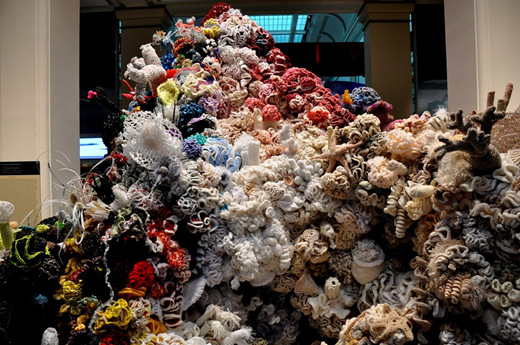
The Hyperbolic Crochet Coral Reef displayed at The Smithsonian, Washington DC. (Photo: Flickr)
Now a global art movement with 40+ community-based ‘Satellite Reefs’, this project offers a means of productive living within the transboundary world of the Anthropocene. Margaret and Christine Wertheim, the project’s creators, have used the increasingly porous borders that delineate our world to create communities of ecological representation. These will continue to create new spaces of knowledge and understanding long into the future.
Communicating through their chosen materials, both of these artworks knot together the themes of responsibility and transboundary living, to seed new understandings of what it might mean to live in this human-made epoch. In doing so, art’s power to speak beyond the written word is delicately captured.
Though Mattingly’s work offers a bleak depiction of our individual impacts on the world, the Hyperbolic Crochet Coral Reef Project offers a counter narrative of hope: global communities can be quickly knitted together in aid of a simple cause. By treading the line between these two understandings, art in the Anthropocene may offer a means of shouldering our individual responsibility without losing hope; a worthwhile project, indeed.
 BioSphere
